
The 2026 National Intellectual Property (IP) Publicity Week has kicked off. Under the guidance of the National Copyright Administration of China (NCAC), local governments and organizations across the country have continued to strengthen coordination and collaboration, carrying out in-depth copyright awareness campaigns. Centering on the theme of “Strengthen IP Protection in Emerging Fields – Expedite New Quality Productive Forces Growth,” these campaigns have showcased the achievements in the high-quality development of China’s IP sector and practical explorations in copyright protection in emerging fields, further highlighting the important role of copyright in promoting innovation and creation, serving industrial development, and ensuring public well-being.
This special issue focuses on key events during the 2026 National IP Publicity Week across China, showcasing the highlights of copyright promotion and the outcomes of innovative practices of various provinces and cities. It presents proactive measures taken by local authorities in mechanism innovation and public guidance, and reflects, from multiple perspectives, the practical outcomes of copyright work in stimulating cultural and creative vitality and driving industrial upgrading.
Beijing: District Synergies Paint a New Copyright Landscape
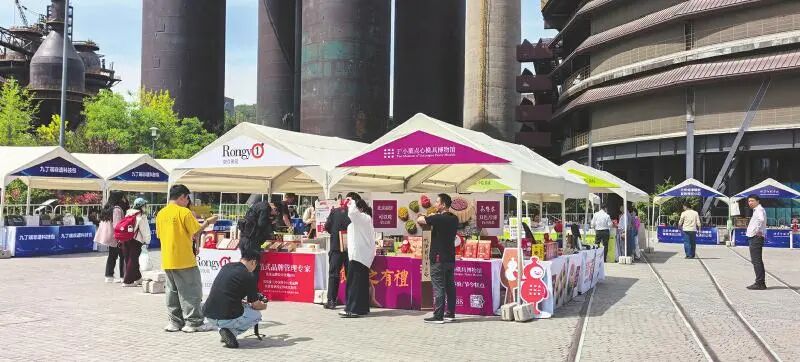
A booth at the Beijing Fu Bing cultural and creative market draws visitors.
The industrial heritage site has been revitalized, becoming a hub where copyright and creativity converge and flourish. On April 26, the Beijing (Beijing-Tianjin-Hebei) copyright-themed event of the 2026 National IP Publicity Week, themed “Strengthen IP Protection in Emerging Fields – Expedite New Quality Productive Forces Growth,” was held at No. 1 Blast Furnace of Shougang Park in Shijingshan District, Beijing.
At the event, the three regions of Beijing, Tianjin, and Hebei jointly released a series of copyright achievements and introduced practical outcomes related to new business forms such as artificial intelligence (AI) and short dramas. Several regional cooperation agreements were also signed, demonstrating the latest progress in collaborative copyright protection in the Beijing-Tianjin-Hebei region.
The Copyright Culture Market, held concurrently during the event, served as an important window into how copyright is being put into practice. The market brought together various cultural and creative products and intangible cultural heritage (ICH) items from the three regions, showcasing achievements in copyright confirmation, transformation, and application. At the Beijing booth, creative products such as clay sculptures, cloisonné, and designer toys were exhibited, reflecting the integrated development of traditional crafts and modern design. The Cizhou Kiln entangled peony patterned cultural and creative products from the Fengfeng Mining Area in Handan, Hebei Province, were particularly well-received and sold out shortly after sales began. Local authorities have also partnered with apparel companies to apply these patterns to Lolita fashion designs, achieving cross-border innovation. The Tianjin booth highlighted the complete chain of copyright “from confirmation to transformation,” where the classic Yangliuqing New Year painting pattern “Surplus over the Years” was reinterpreted through crafts such as electronic wire inlay and enamel color sand painting.
As a significant part of the 2026 Beijing IP Publicity Week, this event is just one example of the city’s broader efforts.
Across Beijing, various districts advanced their work in parallel, each focusing on different development priorities, forming a multi-tiered and multi-dimensional copyright publicity landscape. From April 20 to 26, districts in Beijing focused on launching a series of activities to continuously raise public awareness of respecting innovation and protecting IP.
In Dongcheng District, activities under the theme “Copyright Empowering the Inheritance of Craftsmanship” focused on the protection of copyright for folk literature and art, exploring ways to protect and pass down traditional culture within the modern copyright system through a series of events. Xicheng District, leveraging a “five-scene linkage” approach, extended IP services to business districts, time-honored brands, and small and medium-sized enterprises. Through multi-scenario activities, it worked to integrate copyright protection concepts into market operations and strengthen enterprises’ ability to utilize IP in their day-to-day operations. Tongzhou District carried out its publicity week activities under the theme “Legal Education Protects Innovation, Rule of Law Fosters a Stable Business Environment,” with an emphasis on legal safeguards and the development of foreign-related IP service capacity. By improving institutional support, it helped enterprises enhance their capacity to manage risks in international competition. Huairou District, closely following the theme “Copyright Empowers a Wonderful Beijing,” focused on the film and television culture, and technological innovation sectors, coordinating copyright promotion and protection efforts. It also carried out multi-scenario publicity in business districts, universities, and film-related events, promoting copyright concepts in enterprises, campuses, and grassroots communities.
From key industries to traditional culture, and from technological innovation to business environment optimization, each district, drawing on its own strengths, has continued to expand the depth and breadth of copyright work, further fostering a social atmosphere that respects innovation and protects copyright.